


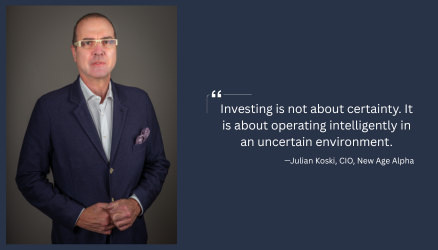
[In the wake of the explosive rise of prediction markets and the nearly $2 billion spent annually on U.S. sports betting advertising, the debate over the difference between gambling and investing has returned with force. At the center of that debate is a provocative argument: much of modern investing, especially in individual stocks, has always been a form of gambling.
Behavioral research has shown that investors and gamblers are often driven by the same psychological impulses. The thrill of uncertainty, the anticipation of reward, and the emotional rush associated with games of chance can push people toward increasingly risky financial decisions. In many cases, the behavior is less rational analysis and more emotional stimulation dressed up as investing.
One of the strongest voices in this debate is Julian Koski, Chief Investment Officer of New Age Alpha, a Rye, New York-based investment management firm. In his white paper, The House Always Wins, Koski argues that the stock market can be a more dangerous form of gambling than a casino because investors rarely know the true odds.
Koski challenges the traditional financial industry narrative that investing and gambling are fundamentally different activities. In his view, both are driven by probability, uncertainty, luck, and human behavior. The difference is that casinos openly disclose the rules of the game, while the stock market often disguises uncertainty behind stories, forecasts, and confidence.
He further contends that long-term investment success depends less on predicting winners and more on managing probabilities and avoiding hidden behavioral risks. That philosophy ultimately led to the creation of New Age Alpha’s proprietary “h-factor score” - a risk measurement system rooted in actuarial science and designed to identify companies where investor expectations have become dangerously disconnected from reality.
“The house always has the odds,” Koski explains. “That’s what our h-factor score is trying to do. Get the odds on our side.”
Rather than treating investing as a prediction exercise, Koski advocates for a disciplined, odds-based framework designed to manage uncertainty the same way professional casinos and insurance companies do - by understanding probability, controlling risk, and refusing to rely on luck alone.]
Hortz: You have argued that much of modern investing, particularly in individual stocks, is functionally no different from gambling. Why do you believe that?
Koski: Because both activities involve risking capital under uncertainty in pursuit of reward. The financial industry tends to frame investing as rational and gambling as reckless, but behaviorally they are often driven by the same human impulses: greed, fear, excitement, overconfidence, and the desire for quick gains.
The real issue is not whether someone calls it “investing” or “gambling.” The real issue is whether they understand the odds. Most investors do not. In a casino, the rules are clear. At least at a roulette table, they tell you the odds.
In the stock market, uncertainty is disguised behind narratives, analyst forecasts, television personalities, and confidence. People feel informed, but often they are simply participating in a more socially acceptable form of speculation.
Hortz: Most people think investing is driven by skill and analysis, while gambling is driven by luck. Why do you believe the line between the two is much thinner than people realize?
Koski: Because outcomes in markets are heavily influenced by forces no investor can fully predict or control.
A company can report strong earnings and the stock falls. A weak company can rally for months on hype. Entire sectors can surge or collapse because of sentiment, liquidity, narratives, or macroeconomic shifts that have little to do with traditional “fundamentals.”
That does not mean skill is irrelevant. It means skill alone is not enough.
The problem is that many investors mistake good outcomes for good decisions. Someone can make a reckless investment and get lucky. Someone else can make a disciplined decision and still lose money in the short term.
That is where probability comes in. Investing is not about certainty. It is about operating intelligently in an uncertain environment.
Hortz: If markets are heavily influenced by randomness and probability, does that change how investors should think about investment success?
Koski: Completely. Most investors are trained to think in terms of prediction: Which stock will go up? Which company will win?
But professional risk managers think differently. They think in terms of probabilities, expected outcomes, and avoiding catastrophic mistakes. That shift changes everything.
You stop asking: “Can I be right?”
And you start asking: “What are the odds I’m wrong, and what happens if I am?”
That mindset is common in actuarial science, insurance, and casino mathematics. Ironically, it is far less common in investing, where confidence and storytelling often dominate decision-making.
Hortz: You often talk about “managing odds” rather than “picking winners.” What does that mean in practice?
Koski: It means accepting that no investor consistently predicts the future with precision. The goal is not perfection. The goal is survival and statistical advantage.
Casinos do not know which hand will win next. Insurance companies do not know which individual person will file a claim next year. But they understand probabilities across large systems and long periods of time. That’s the mindset we believe investors should adopt.
Rather than chasing exciting stories or trying to forecast short-term price movements, we focus on identifying situations where expectations appear disconnected from reality and where the probability of disappointment may be higher than the market realizes.
Over time, consistently improving the odds matters far more than occasionally making spectacular predictions.
Hortz: Can you further explain these mindset examples from other fields that shaped your thinking?
Koski: Moneyball was a perfect example of what happens when emotion, tradition, and narrative are replaced with statistical evidence. Baseball scouts relied on instinct and storytelling. Billy Beane looked for hidden probabilities that the market was mispricing.
Insurance companies operate the same way. They do not eliminate uncertainty. They price it. Casinos do the same thing. They do not need to win every hand. They simply need the odds to favor them over time. Those ideas profoundly influenced our thinking.
The financial industry often behaves as though investment success comes from intelligence alone. But many highly intelligent investors still fail because markets are probabilistic systems, not deterministic ones. Understanding probability is often more valuable than sounding confident.
Hortz: How does your h-factor methodology attempt to put the odds back in the investor’s favor?
Koski: The h-factor was designed to measure hidden behavioral risk embedded in stock prices. Traditional analysis tends to focus on company fundamentals alone. We focus on the relationship between expectations and reality. The more optimistic investor expectations become, the less room there is for disappointment. In many cases, that creates asymmetric risk.
Our h-factor methodology attempts to quantify situations where expectations may have become detached from probable outcomes. In simple terms, we are asking: “How much future success is already priced into this stock?”
That is important because markets are often driven less by what companies actually do and more by whether they exceed or fail to exceed investor expectations.
The h-factor is ultimately an attempt to approach investing the way an actuary approaches risk: probabilistically rather than emotionally.
Hortz: Prediction markets and sports betting platforms are exploding in popularity. What do you think that says about modern investor psychology?
Koski: I think it reveals something very important about human nature. People enjoy uncertainty, competition, and the emotional stimulation that comes from risk-taking. Technology has now made that experience frictionless and available 24 hours a day.
The problem is that the same psychology can easily spill into investing.
Younger investors especially are being conditioned to approach markets the way gamblers approach betting apps: constant activity, constant stimulation, constant prediction. But investing should not primarily be entertainment.
If you are managing your family’s future, retirement, or financial stability, the goal should not be excitement. The goal should be disciplined decision-making under uncertainty.
Those are very different mindsets.
Hortz: Do you think the rise of prediction markets is reinforcing a broader gambling mentality in society and even in the stock market itself?
Koski: Yes, I do. We are seeing a cultural shift where speculation is becoming normalized across multiple platforms simultaneously: sports betting, crypto speculation, prediction markets, meme stocks, options trading, and social media-driven investing.
The danger is not gambling itself. People have always gambled. The danger is when speculative behavior begins masquerading as disciplined investing. That creates a situation where people underestimate risk because the activity feels familiar, social, or entertaining.
At that point, investing can stop being about long-term capital allocation and start becoming a dopamine-driven activity centered around prediction and excitement. That is a very dangerous transition for society.
Hortz: What kind of reactions have you received from investors and the financial industry when you make these arguments?
Koski: Retail investors often understand the argument immediately because many already feel the system is opaque, emotionally driven, and heavily influenced by narratives. Institutional reactions are more mixed.
Some people appreciate the emphasis on probability and behavioral risk because they understand markets are far more uncertain than traditional finance sometimes admits. Others dislike the comparison to gambling because it challenges the image the industry has carefully built around investing.
But I think these conversations are important because they force people to confront uncomfortable realities about uncertainty, risk, and human behavior.
Hortz: What practical advice would you give wealth managers trying to help clients avoid emotionally driven, gambling-like investment behavior?
Koski: The first step is helping clients understand that emotional discipline is part of risk management. Most investment mistakes happen during periods of uncertainty which causes fear, greed, and panic. The challenge is not simply analytical. It’s behavioral.
Wealth managers should spend less time trying to sound certain about the future and more time helping clients understand uncertainty itself. That means reframing investing away from prediction and toward process, probability, diversification, risk management, and long-term discipline.
The best advisors are not just portfolio managers. They are behavioral coaches. Because ultimately, the biggest risk in investing is often not the market. It is human behavior inside the market.
We also make our h-factor system available to financial advisors and institutional investment professionals for free. We have created this toolkit to help advisors and their clients understand investing using probabilities, which is the best way to deal with uncertainty - the cause of behavioral panic.
Financial professionals can use our h-factor system with their clients to look at one individual stock position or apply our h-factor methodology to all the stocks in a mutual fund, ETF, or SMA product or overall portfolio to help adjust the risk parameters in the client’s portfolio.
The Institute for Innovation Development is an educational and business development catalyst for growth-oriented financial advisors and financial services firms determined to lead their businesses in an operating environment of accelerating business and cultural change. We operate as a business innovation platform and educational resource with FinTech and Financial Services firm members to openly share their unique perspectives and activities. The goal is to build awareness and stimulate open thought leadership discussions on new or evolving industry approaches and thinking to facilitate next-generation growth, differentiation, and unique client/community engagement strategies. The institute was launched with the support and foresight of our founding sponsors — Ultimus Fund Solutions, FLX Networks, TIFIN, Advisorpedia, Pershing, Fidelity, Voya Financial, and Charter Financial Publishing (publisher of Financial Advisor and Private Wealth magazines).
Disclaimer: This interview is for informational purposes. Nothing contained herein constitutes investment advice or the recommendation of or the offer to sell or the solicitation of an offer to buy or invest in any specific investment product or service. Before investing, you should carefully consider the investment’s objectives, risks, charges, and expenses. This and other information can be obtained through https://www.newagealpha.com/products-and-strategies#overview and/or contacting your investment advisor. Please read the prospectus and other investment documents carefully before you invest. Investing involves risk, including the possible loss of principal.
Institute for Innovation Development - www.innovationdevelopment.org - @innovationIID - IID©2026





.jpg)
