


[Historically, organic growth processes were rudimentary (e.g., client referrals or email campaigns), but now an expanding focus on “growth intelligence” is quickly becoming the primary value proposition. This is leading to the development of organic growth AI operating systems for wealth management that embed continuous learning, intelligence development, and compliance capabilities, rather than being a tactical marketing platform.
Digital growth intelligence can now power predictable, repeatable, and scalable growth engines that can increase premium firm valuations. This is because potential acquirers can continue firm growth without the founders by using growth intelligence assets that feed a self‑learning model, improve future actions, and form a competitive moat for the firm.
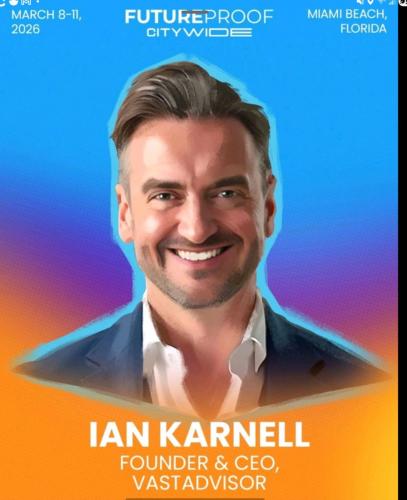
To continue our coverage of the “Organic Growth Crisis in Wealth Management” and learn more about growth intelligence, we spoke with Ian Karnell, CEO of VastAdvisor — an AI-powered organic growth platform and proprietary “agent swarm” designed specifically for RIAs and wealth enterprises. In our discussion, we explored the structural bottlenecks that prevent wealth management firms from executing effective digital campaigns and how AI is collapsing a marketing campaign process that used to take weeks into one that takes minutes.
He argues that marketing often fails due to misalignment between firm narrative and audience intent, and that their AI-Powered Campaign Builder and its nine-step process closes this gap by combining firm identity and Ideal Customer Profile(ICP)‑specific insights to proactively orchestrate campaigns: selecting audiences, defining offers and positioning, choosing channels and ad types, setting budgets, generating assets, and performing inline SEC/FINRA compliance checks via “generative compliance at the architectural level”.
Their centralized growth intelligence layer was designed as a force multiplier for financial firms to help them move from AI pilots to production‑grade enterprise AI, citing data that about 70% of AI initiatives have been shut down or remain stuck in pilot.]
Hortz: What are the primary reasons financial firms have struggled with traditional organic growth processes?
Karnell: The industry built its entire growth motion on three mechanisms, and all three cap out structurally rather than just needing "more effort."
Referrals do not scale because they are not owned. Referral-based growth is overly reliant on somebody else's relationship — a single advisor's or founder's network — which means it cannot be turned on, cannot be forecasted, and evaporates the moment that person leaves or retires. Industry organic growth nets out to roughly 1% once you strip out market appreciation — an anemic rate for a sector sitting on the largest wealth transfer in history.
Lead brokers rent growth instead of building it. These platforms buy traffic cheaply and resell the same lead to multiple competing advisors simultaneously — the arbitrage math runs roughly $55 -$75 cost per lead resold at $300 - $500 — and critically, they never share the signal intelligence (where the lead originated, how it was qualified) back to the firm. A firm using lead brokers learns nothing and owns nothing; the moment it stops paying, the pipeline stops.
The investor profile has fundamentally changed underneath the old playbook. Roughly $120 trillion is shifting hands to digital-first generations (Gen X through Gen Z) who discover, research, and hire advisors in radically different ways than their parents — spending time on Reddit and social channels rather than reading print financial media, and increasingly asking ChatGPT, Gemini, or Claude instead of Googling. Organic site traffic for the whole industry is heading toward a 50% decline in the next couple of years, even as SEO-driven growth erodes.
The deeper structural failure is misalignment, not volume. Where marketing breaks down is usually not the ad itself — it's the disconnect between a firm's generic narrative and the specific intent of the person seeing the ad, and most legacy tools and agencies have no systematic way to close that gap at the pace or cost the channel now demands.
Hortz: How did you design your AI-Powered Campaign Builder into an “organic growth AI operating system” rather than a marketing platform? What is the fundamental difference, and why does that distinction matter for wealth management firms?
Karnell: The design decision was explicit: we positioned VastAdvisor as a governed Al growth operating system — not a marketing platform. Governed means every Al decision made on the platform, through an agent, a sub-agent, or a workflow, is continuously observed and stored so it can be audited, because the SEC requires that level of oversight for any Al used in a market-facing capacity.
The fundamental difference is that a marketing platform executes campaigns; an operating system builds and compounds intelligence.
The approach was not to build a marketing platform, but a growth operating system that enables the wealth management industry — at both the enterprise and RIA level — to start building learning systems that drive organic growth, powered by what we call the Advisor Intelligence Loop, where every signal the platform generates or observes gets pulled in and trains the agents to improve outcomes for the next iteration.
Two architectural choices make this real rather than a marketing claim:
Compliance is built into system architecture, not bolted on as policy. We made a decision to not have compliance at the policy level. We wanted to bring compliance into the system architecture so it auto-checks against SEC and FINRA in line with the same workflows that generate ad assets and target ICPs.
The intelligence layer is the asset; software is not. In a world where everyone has Al and software is commoditized, that is not your competitive moat anymore — your data, and what you do with it, becomes the moat.
This distinction matters for wealth firms because a marketing platform is a rented capability whose value disappears when you stop paying; an operating system is owned infrastructure that compounds — the data, the fine- tuned model, and the audit trail all stay with the firm and keep improving independent of any single vendor relationship or founder.
Hortz: Can you walk us through the steps of what your AI operating system actually does for an advisory firm that wants to launch a campaign?
Karnell: Before a firm ever builds a campaign, an onboarding agent does the foundational work: it scans the firm's website, runs a Google search, reviews the Form ADV, and pulls the LinkedIn page to auto—configure firm settings, identify fee structure and service offerings, and surface the firm's top Ideal Client Profiles (ICPs) — complete with demographic and psychographic insight into pain points, values, and motivators, using core data sources like Pew Research, Meta for Business, and Boston Consulting Group.
Campaign creation itself runs through a structured nine-step wizard (ten steps if starting from an asset or narrative rather than an audience) with three possible starting points — audience-first, asset-first (upload a PDF or webinar URL), or narrative-first (describe the pitch):
Step 1 - Starting point — choose the modality.
Step 2 - Target Niche — select the ICP to target.
Step 3 - Positioning & Offering — the platform takes the firm's general unique value proposition (UVP) and rewrites it to be specific to the audience being targeted, rather than a one-size-fits-all pitch, and pre-selects which service offerings will most resonate with that ICP.
Step 4 - Campaign Themes — the platform generates several Al campaign themes (typically four to six), each with a resonance score reflecting ICP alignment, market conditions, message clarity, and historical click-through data, plus straw-man headline/body/call-to-action (CTA) copy so you can feel the difference before committing. Some themes incorporate real-time market catalysts — an interest rate shift, a regulatory development, a Medicare IRMAA change — pulled from continuous monitoring of economic and regulatory data.
Step 5 - Campaign Identity — the platform auto-names the campaign, writes a description, adds UTM tracking, and assigns an immutable VastlD that follows the campaign through every platform and reporting view.
Step 6 - Channel Mix — the platform assesses every connected ad platform (Google, Meta, LinkedIn, and others) against the specific ICP — audience size, competitiveness, cost to reach, and historical engagement data — and recommends the optimal channel mix and ad format per channel, explicitly excluding platforms that are not a fit and explaining why.
Step 7 - Budget & Return on AD Spend (ROAS) projections — the Al recommends a daily budget and campaign duration (90 or 180 days) and builds forecasts for leads, meetings, new clients, AUM gained, and revenue, calculated per platform and combined into a spend-weighted total so a firm can build a business case before spending a dollar.
Step 8 - Asset Generation with Inline Compliance — the platform builds all ad assets (images, video, carousel formats) while running real-time compliance checks against SEC, FINRA, and (for Canadian RIAs) federal regulatory considerations.
Step 9 - Review & Launch — a full summary (executive Summary, goals, projected performance, ICP, channel mix, compliance overview) that can be finished and launched, downloaded as a PDF, or submitted for compliance approval.
The whole chain is dynamic, not static - change the selected ICP and the UVP, the insights, offering recommendations, and themes to regenerate for the new audience. Once live, every campaign is trackable from a central “Campaigns” view — status, channels, audience, budget, leads generated, conversion rates, and drill-down into hourly performance trends and audience insights.
Hortz: How exactly do you deploy AI agents into an "agent swarm” that autonomously accomplishes this campaign activity? What are your continuing plans for AI agent usage?
Karnell: The platform runs on an agentic framework — a defined roster of specialized agents, each responsible for one part of the growth workflow, operating under firm-configurable guardrails rather than full autonomy.
Agentic, properly defined, means Al that has agency — the ability to understand a task, infer how to solve a problem, and act autonomously — and no firm on the planet is handing its growth strategy over to fully autonomous Al today, especially in a regulated market. So, rather than claim full autonomy, we built an agentic framework where firms can toggle any agent on or off, set sensitivity thresholds (more or less active), and define activation triggers — for example, the Ad Optimization Agent firing only after 24 hours of performance data or when ROAS drops below a set threshold. Even in “Al Autopilot" mode, additional guardrails require manual approval for things like new campaign launches or budget changes, and firms can cap daily budget authority the Al is allowed to exercise on its own.
Where this is headed: the plan is to keep shipping new specialized agents (a geo targeting agent has been discussed, for instance) and to use performance data from every agent action to continually retrain and tune the underlying models, with the long-term trajectory toward real agentic Al — handing an agent a task with the same trust you would give an employee — once confidence in consistent, predictable agent performance is established. We are building toward where the market is going, not where it is today, while keeping governance rails firmly in place until that confidence is earned.
Hortz: What guardrails are placed around the AI agents and how do marketing and compliance teams maintain visibility and final decisions into what the agents are doing?
Karnell: Three layers of guardrails operate simultaneously:
Human-in-the-loop by design, not as an afterthought. The application was designed for Al to do the heavy cognitive lift while keeping a human in the loop at every step — a user selects the ICP, approves or edits the Al-generated UVP and positioning, chooses the campaign theme from Al-ranked options, and reviews the final summary before anything launches.
The agentic framework gives firms direct control knobs. Every agent can be toggled on or off individually; sensitivity thresholds control how actively an agent behaves; activation triggers define exactly when an agent is allowed to act (e.g., only after 24 hours of performance data, or only when ROAS drops below a threshold). Even in Al Autopilot mode, firms can require manual approval specifically for campaign launches, new audience creation, or budget changes, and can hard-cap the daily ad spend an agent is permitted to adjust autonomously.
Compliance has its own dedicated workflow and record. Content flows through an approval path (advisor draft, compliance review, launch) configurable by role. The Compliance Review Agent checks every line of Al and human-generated copy against 13 FINRA violation categories (implied guarantees, misleading risk disclosure, exaggerated claims, etc.), flags issues with a severity score, and the compliance officer has a dedicated workspace showing full campaign context, every flagged item, and three resolution paths: accept the Al's suggested rewrite, accept the risk with a logged justification, or edit manually and resubmit. Every single compliance check and modification a compliance officer makes is captured and stored for seven years.
Everything is logged for regulatory observability. The SEC requires Al telemetry and observability for any Al used in a market-facing capacity — you need to be able to track every Al decision at the agent, sub-agent, and workflow level, time- and date-stamped. Agent IQ captures that full activity log — what happened, what the output was, when it occurred — filterable by date range, campaign, or tenant, and exportable in CSV, JSON, or PDF for regulatory submission.
Hortz: How does the self-learning AI system ensure that faster execution does not lead to faster failures, inappropriate action steps, and detect/correct for drift or degradation in campaign performance over time?
Karnell: Speed is deliberately decoupled from unchecked autonomy through the guardrail layer described above — nothing moves faster than the thresholds, triggers, and manual-approval requirements a firm has configured allows, regardless of how fast the underlying model can act.
On the model-quality side, every campaign run, every lead qualified, and every compliance decision made generates a learning signal that feeds back into the fine- tuned models — all of those signals are aimed specifically at mitigating drift, mitigating latency, mitigating cost, and improving predictability over time, which in turn affects click-through rates, cost per lead, cost per acquisition, and audience targeting precision.
VastAdvisor IQ is the dedicated instrumentation layer for this: it surfaces model performance dashboards — quality scores, latency, hallucination rates, predictive accuracy — and lets a firm (or our own data science team) benchmark their fine-tuned model against the cohort median, see how a new model version impacted click-through rate and cost-per-lead, and drill into drift and latency insights, prediction stability, and data quality. Every model version is tracked, so if a model update underperforms, it can be rolled back.
Regulatory-grade compliance is treated the same way. The Regulatory Monitoring Agent runs 24/7 against SEC and FINRA publication sites, and any new guidance automatically retrains or extends the compliance agent so its judgment does not go stale — the same “learning system" logic applied to the compliance domain specifically, so faster execution doesn't mean compliance falls behind the rules as they change.
Candidly, the honest caveat here is that outcome-level validation — did campaigns that benefited from this learning loop actually outperform over a full market cycle? - is the hardest and slowest layer to prove. It requires enough volume and tenure per firm to be statistically reliable, which is why we are transparent that this compounding benefit is a trajectory we are instrumented to prove out over time, not a static guarantee on day one.
Hortz: How does this growth intelligence provide competitive moat and true differentiators for wealth management firms?
Karnell: The moat argument starts with hard valuation data: firms that had systematized organic growth — repeatable, scalable, predictable, not overly reliant on referrals, lead brokers, or a single rainmaker — saw valuations roughly 200% higher on average than firms still dependent on those older models. That data point, observed while I was building Trulytics (sold to Envestnet), is the founding thesis behind VastAdvisor.
The mechanism behind that premium is ownership versus rental: referral-based growth is opaque and retires when the referral source does; lead-broker growth is rented — the broker never shares the signal intelligence of where a lead came from or how it converted, and you are paying a markup for a lead resold to competitors simultaneously. Systematized, owned growth instead produces something you can actually underwrite – documented/verified credit-for-prior-learning (CPL) the firm controls, audience data that compounds month over month, and a growth system that transfers with the firm rather than with a vendor or a single founder. In a world where everyone has access to Al and software itself is commoditized, your data and what you do with it becomes the moat.
The compounding intelligence layer — the Advisor Intelligence Loop — is what we consider the actual, durable differentiator, not the software shell around it. The more a firm (or, at the enterprise level, a whole advisor network) runs campaigns through the platform, the smarter its targeting, messaging, and compliance judgment get, which is a compounding advantage that's increasingly difficult for a competitor — or a generic Al tool — to replicate, because they would have to start the learning loop from zero.
For an acquirer specifically, this reframes firm value: growth intelligence is an asset that survives a change of ownership. A buyer is not just acquiring AUM and a client list; they are acquiring a self-improving growth engine, audience and compliance intelligence, and a documented, auditable system that keeps producing a qualified pipeline without being dependent on the departing founder's personal network.
The Institute for Innovation Development is an educational and business development catalyst for growth-oriented financial advisors and financial services firms determined to lead their businesses in an operating environment of accelerating business and cultural change. We operate as a business innovation platform and educational resource with FinTech and Financial Services firm members to openly share their unique perspectives and activities.
This interview is for informational purposes only. The goal is to build awareness and stimulate open thought leadership discussions on new or evolving industry approaches and thinking to facilitate next-generation growth, differentiation, and unique client/community engagement strategies. The Institute was launched with the support and foresight of our founding sponsors — Ultimus Fund Solutions, FLX Networks, ETF Global, The Wealth Mosaic, SME Forum, Advisorpedia, Pershing, Fidelity, and Charter Financial Publishing (publisher of Financial Advisor and Private Wealth magazines).
Institute for Innovation Development - @innovationIID - www.innovationdevelopment.org - IID©2026





.jpg)
