


[Organic growth in wealth management has been fundamentally broken. For decades, the industry has built increasingly sophisticated systems to manage, optimize, and scale assets under management — yet comparatively little infrastructure has been built around the systematic acquisition of new client relationships. Documented by a wide cross-section of credible industry research and surveys, the result has been an industry with organic growth rates in the low single digits, typically up to 5% for RIAs. This leaves firms heavily dependent on referrals, legacy networks, and increasingly expensive lead-generation models.
At the same time, the largest generational wealth transfer in history is underway. What began as Cerulli Associates’ original $84 trillion estimate has been revised upward in their June 2024 report to $124 trillion expected to transfer over the next 25 years — primarily to Millennials and Gen Z. These generations discover, evaluate, and select financial advisors in a fundamentally different manner than prior generations. Trust formation is increasingly digital, algorithmic, content-driven, and mobile-first. The implications are enormous and position the industry’s organic growth rate in a crisis scenario, if not addressed.
Compounding this shift is the rapid emergence of AI across financial services. While AI creates transformative opportunities for scale, personalization, and operational efficiency, it also introduces serious governance, compliance, and reputational risks in regulated industries.
The firms that succeed over the next decade will not simply be those with the best investment portfolios, but those that also address this organic growth crisis. They will be the firms that build modern organic growth infrastructure — combining distribution, data, paid media, governed AI, compliance oversight, and continuous learning into a unified operating model.
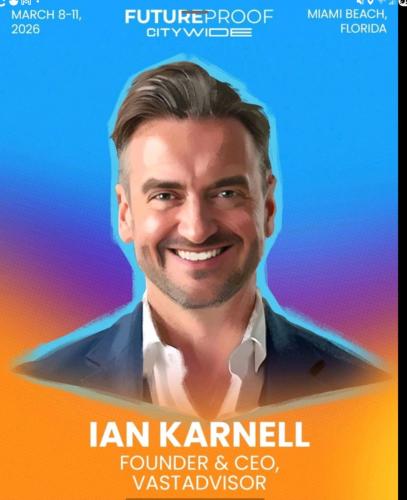
To better understand these industry shifts and the emergence of AI-native growth systems in wealth management, we spoke with Ian Karnell, CEO of VastAdvisor - an AI-powered organic growth platform designed specifically for RIAs and wealth enterprises. We asked him questions on how exactly he positioned his firm as a disruptive force against both traditional industry growth models and the risky, ad-hoc adoption of generic AI.]
Hortz: Tell us about your previous experience. How did you get involved with this specific financial technology area targeting organic growth?
Karnell: My background has always sat at the intersection of technology, data, and operational systems. Before founding VastAdvisor, I built and exited a WealthTech company called Trulytics, which was ultimately acquired by Envestnet.
At Trulytics, we spent years analyzing the operational and financial performance of advisory firms across the industry. One pattern became impossible to ignore: the firms with durable enterprise value were not simply the firms with the best investment performance or largest books of business. They were the firms that had built repeatable, systematized growth engines. That realization stayed with me.
At the same time, I became increasingly fascinated by how far behind wealth management was in terms of modern client acquisition infrastructure compared to nearly every other major industry. Most industries long ago developed sophisticated systems for audience development, digital distribution, attribution, performance marketing, and customer acquisition optimization. Wealth management largely did not.
Instead, the industry remained deeply dependent on referrals, inherited relationships, and purchased leads. That model worked for a long time because markets expanded, demographics were favorable, and referrals were sufficient. But the environment has fundamentally changed.
The catalyst for us was recognizing that the Great Wealth Transfer would collide directly with a generational shift in how trust is formed and how financial relationships are discovered. Millennials and Gen Z are digital-first generations. They validate trust online. They research through algorithms. They are discovering financial guidance through YouTube, Instagram, TikTok, podcasts, AI tools, search engines, and social algorithms. Increasingly, they even interact directly with AI during financial decision-making. That creates both a massive opportunity and a huge infrastructure gap across wealth management.
Hortz: Can you further discuss the primary problems challenging wealth management firms that your efforts are solving for?
Karnell: The core problem, as I just discussed, is that the industry has not optimized around systematically generating organic growth. That may sound obvious, but it is actually a profound structural issue.
For decades, wealth management firms built sophisticated infrastructure around portfolio management, custodial systems, reporting, trading, risk analytics, and operational scale. Yet many firms still rely on highly fragmented, manual, or outdated approaches to client acquisition. The industry’s persistently low organic growth rate, as low as 1%-5%, reflects that reality.
Historically, referrals compensated for the lack of growth infrastructure. But referrals are becoming less predictable and less scalable, particularly as younger generations increasingly discover and validate advisors digitally before ever engaging directly.
The second major issue is the growing inefficiency of traditional lead-generation models. Many firms are now spending substantial amounts purchasing leads from aggregators or referral marketplaces without actually building owned distribution, owned audience, or long-term brand equity. In many cases, firms are effectively renting growth instead of compounding it.
The third issue is AI adoption itself. Right now, many firms are experimenting with generic AI tools that were never designed for regulated environments. That introduces enormous compliance, reputational, governance, and auditability concerns.
We believe regulated industries require governed AI systems — not simply generative AI layers. There is a major difference between AI that generates content and AI that operates within embedded governance frameworks designed around SEC and FINRA requirements.
That distinction will become increasingly important over the next several years.
Hortz: How exactly did you design your platform to address those challenges?
Karnell: We designed VastAdvisor around the idea that organic growth should function more like an intelligent operating system than a collection of disconnected marketing tools.
At the center of the platform is what we internally call the Advisor Intelligence Loop — a continuous learning system that analyzes campaign performance, audience behavior, engagement signals, conversion data, compliance outcomes, and acquisition efficiency over time.
The core principles we envision are:
- Every campaign generates intelligence.
- Every interaction improves targeting.
- Every dollar ideally compounds more efficiently than the last.
The objective is not simply lead generation. It is the creation of an adaptive organic growth infrastructure that improves continuously.
Equally important is governance. One of the biggest misconceptions around compliance is that it only acts as a constraint on innovation. We believe the opposite is increasingly true. In regulated industries, governance becomes an accelerator because it enables firms to scale AI adoption confidently, instead of cautiously.
That means embedding review systems, auditability, approval workflows, policy enforcement, and compliance oversight directly into the operational architecture itself — not bolting it on afterward. We believe “embedded governance” will become a foundational requirement for AI systems operating inside financial services.
Hortz: What are the benefits that this platform structure brings to wealth management firms?
Karnell: The immediate benefit is that firms begin building owned growth infrastructure rather than remaining dependent on external lead ecosystems. That changes the economics dramatically over time.
When firms build digital authority, audience intelligence, search visibility, content systems, paid media optimization, and governed AI into a unified operating model, client acquisition becomes increasingly compounding instead of increasingly expensive.
The firms that we believe will outperform over the next decade will not necessarily be the firms spending the most on marketing. They will be the firms building the most intelligent and adaptive acquisition systems.
Our goal is to help firms in that pursuit:
- reduce customer acquisition costs,
- improve attribution,
- strengthen digital authority,
- increase organic discovery,
- improve conversion quality,
- and ultimately compound AUM growth more efficiently.
All while maintaining governance and regulatory oversight across every campaign, channel, and asset.
Hortz: Can you explain more about your emphasis on learning? Why is it such a central design component of your platform and a major benefit for advisors and firms?
Karnell: Because static marketing systems are increasingly ineffective in dynamic digital environments. Consumer behavior changes constantly. Platforms evolve constantly. Algorithms evolve constantly. Audience expectations evolve constantly. The firms that win are the firms that learn the fastest.
One of the major problems with generic AI is that it often creates scale without intelligence. It generates enormous volumes of content or activity, but not necessarily institutional knowledge. We believe the future belongs to systems that continuously learn from outcomes:
Which messages convert?
Which channels produce trust?
Which audiences engage?
Which campaigns lower CAC?
Which creative assets improve advisor discovery?
Which compliance patterns create friction?
Which content drives branded search behavior?
That accumulated intelligence becomes a strategic asset over time. In many ways, the future competitive advantage in wealth management may not simply be assets under management. It may increasingly be intelligence under management.
Hortz: What is your vision for the future of wealth firms?
Karnell: I believe the next generation of leading wealth firms will operate much more like modern media and distribution organizations. That does not mean abandoning fiduciary advice or human relationships. Quite the opposite. Human trust becomes even more important. But the mechanisms through which trust is established are changing dramatically.
Historically, advisor discovery was highly localized and relationship driven. Increasingly, it is digital, algorithmic, content-driven, and continuously validated online. The firms that establish digital authority early will have enormous long-term advantages as the Great Wealth Transfer accelerates.
I also believe AI will fundamentally reshape the operational structure of advisory firms. But the winners will not simply be firms using AI. They will be firms using governed AI systems designed specifically for regulated environments.
The future wealth firm will likely combine:
- human advisors,
- intelligent automation,
- digital distribution,
- governed AI,
- continuous learning systems,
- and embedded compliance infrastructure.
In many ways, we are watching wealth management evolve from a relationship-only industry into a relationship-plus-distribution industry. That transition is already underway.
The Institute for Innovation Development is an educational and business development catalyst for growth-oriented financial advisors and financial services firms determined to lead their businesses in an operating environment of accelerating business and cultural change. We operate as a business innovation platform and educational resource with FinTech and Financial Services firm members to openly share their unique perspectives and activities. This interview is for informational purposes only. The goal is to build awareness and stimulate open thought leadership discussions on new or evolving industry approaches and thinking to facilitate next-generation growth, differentiation, and unique client/community engagement strategies. The Institute was launched with the support and foresight of our founding sponsors — Ultimus Fund Solutions, FLX Networks, ETF Global, TIFIN, Advisorpedia, Pershing, Fidelity, Voya Financial, and Charter Financial Publishing (publisher of Financial Advisor and Private Wealth magazines).
Institute for Innovation Development - www.innovationdevelopment.org - @innovationIID - IID©2026





.jpg)
